- Patent
- Our Patent solutions
- IP Intelligence SoftwareStreamline the journey from innovation to IP with our IP intelligence software, patent search, data analytics, and related services and tools.→ Read more
Our solutionsPowerful patent searching and analysisArtificial intelligence for patent classificationGrant statistics and detailed legal status analysisSmall molecules searching and analysisDNA and amino acid searching and analysisExplore new markets and opportunitiesEasy patent searching and collaborationAnalysis from any scientific sourcesUnlock AI-powered use cases across a range of Questel software.SEP DatabaseNEWStandard Essential Patent Data & AnalyticsLatest resources- → Questel’s Orbit Intelligence selected by HORIBA ABX SAS to Strengthen Its Patent Intelligence CapabilitiesHORIBA ABX SAS has selected Orbit Intelligence and expects to benefit from powerful ...
- → [AI Patent Software Reviews] <br>Why Scitech Trusts Orbit Intelligence for High‑Quality Patent Research With a team of 100+ IP and technology professionals, Scitech works with corporations...
- → Enovix Selects Questel’s IP Intelligence Software: Orbit Intelligence Enovix is an advanced battery technology company focused on developing high-performa...
- → Questel’s Orbit Intelligence selected by HORIBA ABX SAS to Strengthen Its Patent Intelligence Capabilities
- IP Management SoftwareKeep your assets up to date and aligned with your corporate strategy with our Equinox suite of IP management software.→ Read more
Our solutionsPowerful all-in-one IPMS for corporatesIPMS tailored for large corporates, built on SalesforcePowerful all-in-one IPMS for law firmsIPMS tailored for large Law FirmsCollaborative invention-to-filing workflowLatest resources- → Fideon Selects Questel's Equinox Law Firm to Streamline IP Management Questel announces that Fideon, a leading Dutch intellectual property consultancy, ha...
- → Unlock the Power of Integration in Your IP Management SystemImagine how much time you could save with an IP management system (IPMS) that connec...
- → How to Leverage GenAI for Advanced Patent and Trademark WorkflowsFrom invention disclosure and patent drafting to office action response management a...
- → Fideon Selects Questel's Equinox Law Firm to Streamline IP Management
- AI Assistants for Patent ProductivityOptimize your entire patent process with our advanced AI assistants for patent productivity, from patent application drafting to prosecution workflow automation, claims mapping, and office action responses.→ Read more
Our solutionsQthenaNEWAll-in-one patent prosecution workflow, data, and collaboration workspace.Patent Mapping and Claim Analysis with AIPatent Office Action Response Management with AILeverage the power of data to guide your patent prosecution with Prosecution PackIndustry-leading patent drafting software powered by generative AI.Latest resources- → AI-Assisted Systematic FTO with QthenaDiscover how to safely leverage specialized patent AI to accelerate searching, strea...
- → The Trademark Attorney’s Playbook for AI82% of intellectual property (IP) professionals plan on increasing their use of AI i...
- → The Top 5 FTO Pain Points Patent Professionals Face Today, and How AI Is Changing the Workflow Despite what is at stake, the traditional FTO process remains agonizingly manual for...
- → AI-Assisted Systematic FTO with Qthena
- Patent ServicesBenefit from end-to-end support for vital but time-consuming administrative tasks with our complete range of patent support services, including searches, translations, international filings, validations, unitary patent management, recordals, renewals, and more→ Read more
Our solutionsPatentability, Freedom-To-Operate, InvalidityPCT & national phase, Paris Convention, Unitary PatentUnitary Patent and Unified Patent Court servicesSimplified European validation servicesCentralized patent translation servicesFee and renewals managementAssignment and recordal of all IP RightsLatest resources- → EP VALIDATION COUNTRY GUIDECountry-by-country validation requirements across EPO member states and validation s...
- → Patent Medications: From Historical Remedies to Modern Drug Protection Explore the evolution of patent medications, from 19th-century remedies to modern ph...
- → How Leading IP Teams Address Common Patent Filing Challenges Why do some IP teams manage global patent filings efficiently while others struggle ...
- → EP VALIDATION COUNTRY GUIDE
- Patent Strategy & Administration→ Read more
Control costs, streamline invoices, and safeguard your patent rights efficiently with our patent strategy & administration services and tools
Our solutionsEnd-to-end IP admin, data verification and docketingInvoice review, bundling and paymentFee audits, negotiation, compliance, benchmarks and forecastingLandscaping, benchmarking, valuation and licensingDefensive PublicationBUY ONLINEPublish an invention into the public domainLatest resources- → How Leading IP Teams Address Common Patent Filing Challenges Why do some IP teams manage global patent filings efficiently while others struggle ...
- → Intellectual Property Classification: Systems, Structure, and Strategic Value Intellectual property classification systems play a vital role in organizing, search...
- → Cut Intellectual Project Cost and Reduce Inefficiency: What Can In-House Legal Teams Do? There is always pressure on intellectual property costs. Indeed, an in-house legal t...
- → How Leading IP Teams Address Common Patent Filing Challenges
- Trademark
- Our Trademark solutions
- Clearance & Watch PlatformScreen and monitor your brand and trademark rights effectively with our trademark clearance search and trademark monitoring platform→ Read more
Our solutionsScreen trademarks with AI-driven search technologyMarkify Comprehensive SearchBUY ONLINEAI-driven trademark availability softwareBest-in-class trademark results paired with key pharmaceutical sourcesWatch for new, identical and confusingly similar trademarksLatest resources- → Can AI Elevate Your Brand Protection Process? Brand protection is no longer just about safeguarding trademarks; it’s about protect...
- → TALKUAL Selects Markify Watch to Strengthen Its Brand Protection Strategy As TALKUAL continues its international growth journey, protecting and strengthening ...
- → Pointon Partners Selects Questel’s Markify Platform to Screen and Monitor Brand and Trademark Rights EffectivelyWe are excited to announce that Pointon Partners has selected Markify, our trademark...
- → Can AI Elevate Your Brand Protection Process?
- IP Management SoftwareManage and maintain your trademark, design and domain name rights effectively with our state-of-the-art trademark management software→ Read more
Our solutionsPowerful all-in-one IPMS for corporatesIPMS tailored for large corporates, built on SalesforcePowerful all-in-one IPMS for law firmsIPMS tailored for large law firmsCollaborative workflow for trademark and design proposalsLatest resources- → Unlock the Power of Integration in Your IP Management SystemImagine how much time you could save with an IP management system (IPMS) that connec...
- → How to Leverage GenAI for Advanced Patent and Trademark WorkflowsFrom invention disclosure and patent drafting to office action response management a...
- → 7 Data Security Features You Need in Your IP Management SoftwareIP management software is evolving rapidly, with vendors and users embracing the pot...
- → Unlock the Power of Integration in Your IP Management System
- AI Assistants for Trademark ProductivityReview trademark search and watch results, create first drafts of goods and services descriptions, classify evidence of use, and manage office action responses effectively with Qthena, our AI assistant for trademark productivity.→ Read more
Our solutionsQthenaNewAll-in-one digital trademark workflow automationChat with trademark search or watch results to review findings and assess riskSave time and build consistency and compliance with our AI solutionAnalyze content and draft answers with AIManage trademark evidence of use with AILatest resources- → Beyond Filing: Managing Proof of Use for Trademark Rights Managing proof of use for trademark rights is not always glamorous. However, overloo...
- → The Trademark Attorney’s Playbook for AI82% of intellectual property (IP) professionals plan on increasing their use of AI i...
- → How Can AI Help IP Practitioners Manage Responses to Office Actions? The latest AI tools for IP law firms and corporations are helping IP practitioners s...
- → Beyond Filing: Managing Proof of Use for Trademark Rights
- Trademark, Design & Domain Services→ Read more
Access expert support throughout the complete brand lifecycle with our integrated domain name, design, and trademark solutions
Our solutionsAnalyst-driven searches with on-demand and customizable reportingIP asset monitoring with intelligent pre-selectionCase management and take-down servicesInternational registration process supportTrademark and design renewal servicesEffective management of corporate domain namesAssignment and recordal of all IP rightsEnd-to-end IP admin, data verification, docketingLatest resources- → Beyond Clearance: A Smarter Approach to Trademark SearchWatch the recording to discover how a smarter, more strategic approach to trademark ...
- → Trademark Applications: Types, Process, and Filing Requirements Filing a trademark application is a critical step in protecting your brand identity....
- → Trademark Classes: A Complete Guide to the Nice Classification System Understanding trademark classes is essential for securing the right protection for y...
- → Beyond Clearance: A Smarter Approach to Trademark Search
- Innovation
- Our Innovation solutions
- Innovation Management SoftwareMake your innovation management processes faster, efficient and scalable with our end-to-end innovation management platform.→ Read more
Our solutionsBusiness-oriented dashboards for innovatorsStartup deal flow and program managementInnovation Project ManagementUnlock AI-powered use cases across a range of Questel software.Your central cockpit for your strategic AI projectsLatest resources- → The Critical Role of Human Input in AI-Powered DecisionsWhy AI needs human input to deliver business value, and how innovation leaders are i...
- → How to Choose the Best Open Innovation Platform for Your Business NeedsYour innovation platform should provide a dynamic space where you can share ideas, t...
- → Why You Should Focus on Innovation Even at Times of Crisis Investing in innovation and innovation management is essential not only during stron...
- → The Critical Role of Human Input in AI-Powered Decisions
- Innovation ServicesSuccessful innovation processes and culture are about more than the right software tools. Our innovation services leverage proven methods and approaches to generate insights, ideas, and solutions.→ Read more
Our solutionsMarket screening, Competitive intelligence and Technology scoutingConnect with partners, improve or localize your innovation processProducts and services namingSeamless user experience to a global audienceEngage with new audience globallyLatest resources- → 7 Key Questions to Measure Innovation Management Success Innovation is the key to staying competitive in today’s fast-paced business world. H...
- → Software Patent: How Can It Be Done?Even though life without computers is today nearly impossible to imagine, patent-bas...
- → What is Innovation Scouting?Change is a constant. New technologies emerge regularly, reshaping product landscape...
- → 7 Key Questions to Measure Innovation Management Success
- Solutions
- Solutions
- Artificial Intelligence in IP→ Read more
Discover Questel’s holistic and responsible approach to artificial intelligence
and intellectual property and our vision to inspire the future of IP with AI
Our solutionsDiscover how AI is transforming IPIndustry-leading patent drafting software powered by generative AIAI copilots for optimized patent preparation and prosecution workflowsAI copilot for automated patent classificationAI copilot for elevated trademark clearance searchUnlock AI-powered use cases across a range of Questel software.Proof of UseNewCapture Trademark Evidence of Use with AILatest resources- → From Manual to Mindful: The Benefits of Integrating Intellectual Property and AI Systems Discover how integrating intellectual property and AI systems boosts automation, imp...
- → The Top 5 FTO Pain Points Patent Professionals Face Today, and How AI Is Changing the Workflow Despite what is at stake, the traditional FTO process remains agonizingly manual for...
- → From Risk to Reward: What Our 2026 Industry Outlook Research Reveals About AI in IPThe latest edition of our IP Industry Outlook Research shows that AI is providing a ...
- → From Manual to Mindful: The Benefits of Integrating Intellectual Property and AI Systems
- Integrated IP Ecosystem→ Read more
Optimize your intellectual property assets with our comprehensive IP portfolio management solutions,
ensuring maximum protection and strategic advantage for your business.
Our solutionsIP management systems, docketing, forecasting, data analytics, blockchain, and eBilling toolsOur web-based platform for IP services managementPAVIS Connect, our solution for companies and laws firms that already have an IP management systemAccess trademark watches directly from Equinox with Markify Watch integrationLatest resources- → Intellectual Property Classification: Systems, Structure, and Strategic Value Intellectual property classification systems play a vital role in organizing, search...
- → Types of Intellectual Property: Definitions, Examples, and Strategic Value Understand the key types of intellectual property—patents, trademarks, copyrights, a...
- → IP Valuation Services for Smarter Business DecisionsIn today’s knowledge-driven economy, intellectual property (IP) assets often hold mo...
- → Intellectual Property Classification: Systems, Structure, and Strategic Value
- Solutions for Law FirmsStreamline internal processes, satisfy client demand, and remain competitive with our specialist solutions for law firms→ Read moreOur solutionsAll-in-one patent prosecution workflow, data, and collaboration workspace.Patent Office Action Response Management with AIIndustry-leading patent drafting software powered by generative AIPowerful all-in-one IPMS for law firmsPowerful patent searching and analysisScreen and monitor your trademark rights effectively with our Markify platformStreamline multilingual matters with fast and reliable legal translation servicesCentralized patent translation servicesFee and renewals managementTrademark and design renewal servicesLatest resources
- → How Equinox Law Firm Supports Redchip Lawyers to Save Time and Build RelationshipsFor law firms with large, multi-disciplinary practices, an IP management system (IPM...
- → Can Your IPMS Help Build Strong Client Relationships?Cultivating strong client relationships is incredibly important for IP law firms. Yo...
- → Leverage Artificial Intelligence to Simplify Your Prosecution WorkUnlock exclusive insights and discover how Qthena, the AI-powered prosecution assist...
- → How Equinox Law Firm Supports Redchip Lawyers to Save Time and Build Relationships
- Solutions for Life Sciences→ Read more
Intellectual property management tools, services, and insights to support life sciences innovation strategies
Our solutionsDNA and amino acid searching and analysisSmall molecules searching and analysisExplore new markets and opportunitiesBest-in-class trademark results paired with key pharmaceutical sourcesPowerful all-in-one IPMS for corporatesTranslation solutions across the product lifecycle—from patent to post-marketCentralized patent translation servicesFee and renewals managementTrademark and design renewal servicesLSPN North America Awards recognize QuestelLatest resources- → Patent Data Analytics, It’s Not Just for Patent SearchingThere are many reasons why organizations may conduct patent searching exercises and—...
- → Harnessing the Power of Patent AnalyticsPatent analytics can reveal new application areas, diversification opportunities, an...
- → The Technology Landscape of Precision Medicine: An IP AnalysisTechnological developments in gene sequencing, imagery, and data analysis are enabli...
- → Patent Data Analytics, It’s Not Just for Patent Searching
- Solutions for R&D and Innovation→ Read more
Strengthen, structure, and maximize your R&D and innovation strategy, workflows, and internal processes by harnessing the latest tools and technologies, including through smart application of generative AI.
Our solutionsCreate more efficient and scalable innovation management processesCollaborative invention-to-filing workflowCollaborative worklfow for trademark and design proposalsMarket screening, competitive intelligence, and technology scoutingStreamline your research and development workflows with AILatest resources- → 3 Cutting-Edge Solutions to Support Your R&D and Innovation Strategies Discover how the latest cutting-edge software and AI-elevated processes for research...
- → 7 Key Questions to Measure Innovation Management Success Innovation is the key to staying competitive in today’s fast-paced business world. H...
- → AI Patents: What Patent Mapping Can Tell Us About Future AI Technologies Artificial intelligence (AI) is evolving all the time thanks to the growing quantiti...
- → 3 Cutting-Edge Solutions to Support Your R&D and Innovation Strategies
- Language Solutions→ Read more
Translation, interpretation and tech-enabled localization services and language solutions that help global organizations open up new markets, overcome regulatory hurdles and connect with audiences worldwide.
Our solutionsStreamline multilingual matters with fast and reliable legal translation servicesTranslation solutions across the product lifecycle—from patent to post-marketManage operations, ensure compliance, and maintain consistent messaging worldwideLatest resources- → Creating Organization-Wide IP Awareness: How Leading Companies Strengthen Innovation and Reduce RiskHaving an organization wide IP Awareness is essential! But how companies can build a...
- → Employing A "Winning Strategy" For Your International MattersYear after year, in-house legal teams and outside counsel handling international and...
- → The Role Clinical Trial Translation Plays in Patient Recruitment and RetentionHealth equity is an essential goal in modern healthcare, and one pivotal aspect of a...
- → Creating Organization-Wide IP Awareness: How Leading Companies Strengthen Innovation and Reduce Risk
- Contact
- Learn & Support
- Learn and support
- Webinars & EventsAre you interested in attending one of our online or onsite event?
- Product TrainingsCustomer success is our priority. Increase your skills in the use of Questel’s software
- Product NewsA platform dedicated to software and platforms news and evolutions
- Best-in-class Customer ExperienceOur goal is to exceed our clients' expectations and share best practices
- IP TrainingIncrease the IP-IQ of your entire organization with engaging IP training programs
- Newsletter subscriptionSign up for our quarterly patent and trademark newsletters and set your email preferences below.
- Webinars & Events
- Resource HubStay up-to-date with industry best practices with our latest blogs
- Resource Hub
- About Questel
- Learn & Support
- Learn and support
- Webinars & EventsAre you interested in attending one of our online or onsite event?
- Product TrainingsCustomer success is our priority. Increase your skills in the use of Questel’s software
- Product NewsA platform dedicated to software and platforms news and evolutions
- Best-in-class Customer ExperienceOur goal is to exceed our clients' expectations and share best practices
- IP TrainingIncrease the IP-IQ of your entire organization with engaging IP training programs
- Newsletter subscriptionSign up for our quarterly patent and trademark newsletters and set your email preferences below.
- Webinars & Events
- Resource HubStay up-to-date with industry best practices with our latest blogs
- Resource Hub
- About Questel

Shaping the Future of Autonomous Mobility: Innovation in Quantum Sensing Technologies
Quantum sensing technologies have the potential to drastically enhance both the safety and decision-making intelligence of self-driving systems. From emerging technologies to innovation hubs and leading industry players, Manar Mekki explores what Questel’s patent landscape analysis reveals about the shift towards quantum precision in autonomous mobility.
The rise of autonomous vehicles (AVs) relies on highly accurate perception systems capable of continuously understanding their surroundings. Today’s sensing architecture typically combines cameras, radar, and light detection and ranging (LiDAR); however, these technologies still face significant performance degradation under challenging conditions such as heavy rain, fog, low-light environments, or visually complex road scenarios. As a result, perception uncertainty remains a key barrier to full autonomy. Quantum sensing technology has emerged as a breakthrough solution by pushing the boundaries of sensitivity, resolution, and robustness far beyond classical sensing.
Part 1: Understanding Quantum Sensing:
The New Backbone of Autonomous Mobility?
Leveraging quantum phenomena such as atomic interferometry, entangled photons, and quantum magnetometry, quantum sensing technologies can maintain exceptional accuracy regardless of visibility or weather. By delivering earlier obstacle detection, providing ultra-precise measurements of position and navigation, more reliable localization, and improved object differentiation, quantum sensing has the potential to drastically enhance both the safety and decision-making intelligence of future self-driving systems.
The Quantum Leap in Autonomous Navigation: Challenges and Opportunities
Autonomous vehicles (AVs) do not all face the same operational constraints. To truly understand where quantum sensing brings the highest value, it is essential to distinguish the different categories of autonomous systems and the unique perception challenges they must overcome.
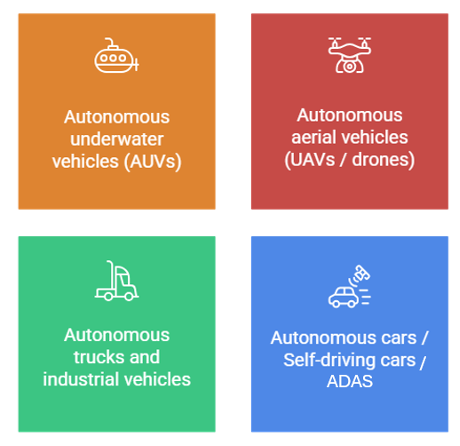
Figure 1: Types of Autonomous Vehicles (AVs)
- Autonomous Underwater Vehicles (AUVs): These systems operate in complex underwater environments, performing tasks such as inspection, mapping, and environmental monitoring without human intervention.
- Autonomous Aerial Vehicles (UAVs/Drones): UAVs are widely used for surveillance, logistics, mapping, and commercial services thanks to their flexibility and rapid deployment capabilities.
- Autonomous Trucks and Industrial Vehicles: These vehicles automate material handling, logistics, and heavy-duty transport across industrial sites, warehouses, and controlled environments.
- Autonomous Cars/Self-Driving Cars (including ADAS): Self-driving cars and Advanced Driver Assistance Systems (ADAS) combine sensing, perception, and decision-making technologies to support partial to full autonomy on public roads.
A quantum sensor utilizes quantum phenomena, such as superposition, entanglement, and tunneling, to measure physical quantities (like magnetic fields, acceleration, rotation, or gravity) with exceptional accuracy.
Quantum sensors utilize the principles of quantum mechanics to measure physical quantities with unique precision and sensitivity. By tapping into the quantum properties of particles, these sensors can achieve extreme accuracy in detecting changes in gravity, magnetic fields, temperature, and other environmental factors.
Quantum sensors do not replace classical perception; they extend autonomy into environments where classical sensing cannot guarantee safety.
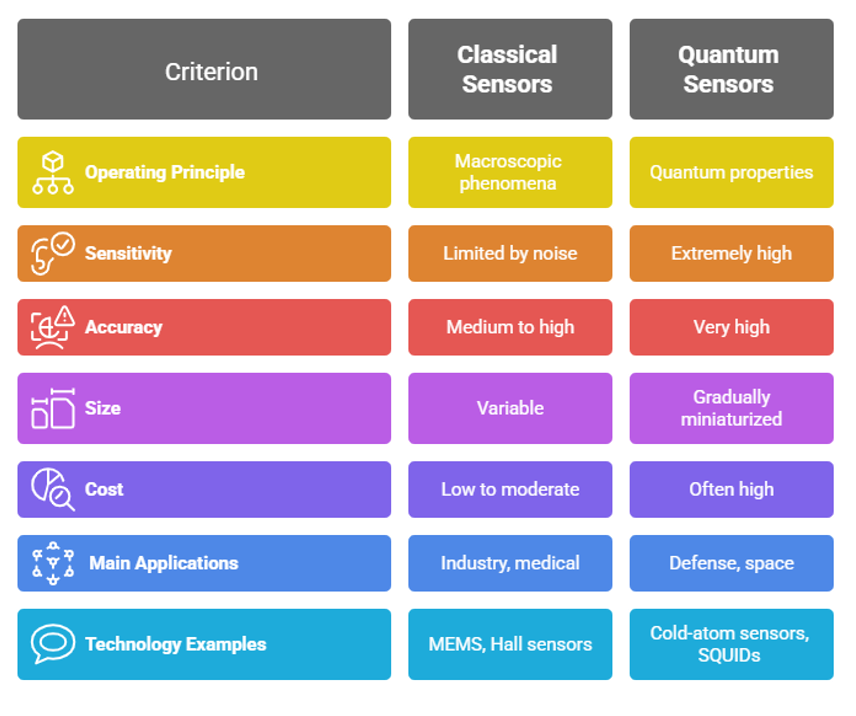
Figure 2: Classical Sensors VS Quantum Sensors in AVs
The comparison between classical and quantum sensors highlights both technological and economic contrasts. Classical sensors are valued for their reliability and cost-effectiveness, making them well-suited for widespread industrial and automotive applications. However, they are limited by noise and restricted sensitivity, which can affect measurement accuracy in complex environments. In contrast, quantum sensors offer ultra-high sensitivity and precision, enabling detection at atomic or subatomic levels, ideal for next-generation navigation and perception systems. Yet, their technological complexity and high production cost currently hinder large-scale adoption, keeping them primarily within research and specialized sectors such as defense, aerospace, and scientific instrumentation.
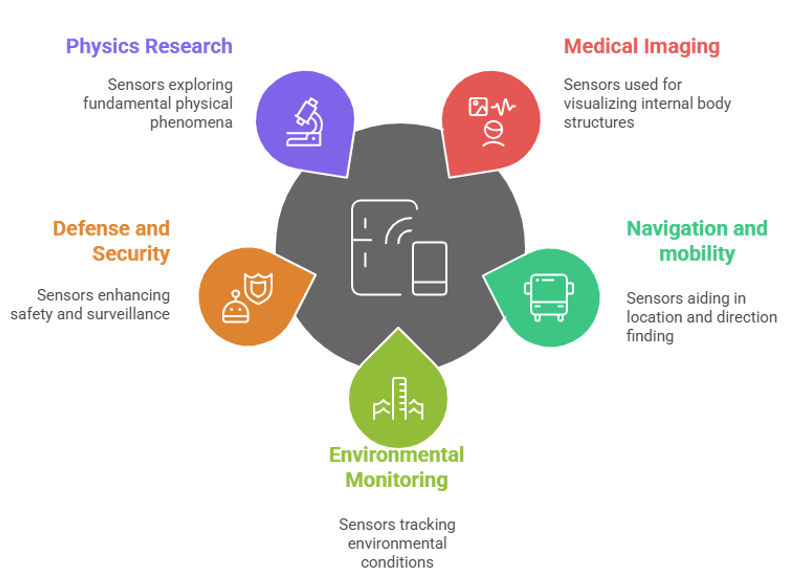
Figure 3: Applicability of Quantum Sensors in Different Industries
Quantum sensors are used across many sectors, including medical imaging, automotive navigation, environmental monitoring, defense, and scientific research, thanks to their extremely high sensitivity to magnetic, gravitational, and acceleration fields. The automotive sector represents the largest market share, driven by the growing integration of advanced sensing technologies in ADAS and autonomous vehicles. These sensors provide highly accurate measurements essential for safety, navigation, and real-time decision-making.
The global quantum sensors market size was valued at USD 377.3 million in 2024 and is projected to grow from USD 435.0 million in 2025 to USD 1,211.5 million by 2032, exhibiting a compound annual growth rate (CAGR) of 15.8% during the forecast period.
The types of quantum sensors used in AVs include:
1. Quantum Inertial Sensors
- Work as ultra-precise accelerometers and gyroscopes.
- Use cold atoms trapped by lasers to detect acceleration and rotation.
- Provide accurate navigation in GPS-denied areas, such as tunnels or urban canyons.
2. Quantum Magnetometers
- Detect magnetic field variations with extreme sensitivity.
- Help with mapping road infrastructure and underground features (tunnels, pipelines).
- Support localization when visual or radar inputs fail.
3. Quantum Gravimeters
- Measure local gravity variations caused by underground structures.
- Can be used for road safety analysis and advanced navigation.
4. Quantum LiDARs
- Uses single-photon quantum states for detecting objects.
- Provides high-resolution imaging with better penetration in fog, dust, or rain.
- In the Autonomous vehicle sector, quantum magnetometers can estimate battery life with sensitivity improved by an order of magnitude versus legacy technologies, potentially addressing some range anxiety.
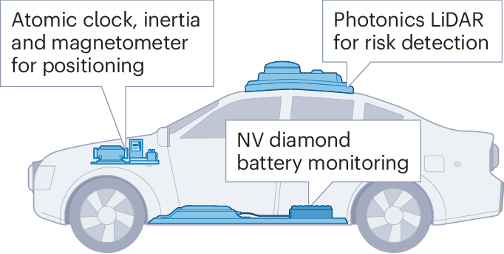
Figure 4: Integration of Quantum Sensing in AVs
Part 2: Mapping the Quantum Race
:How Do Patent Trends Signal the Future of Autonomous Navigation?
To understand the innovation and R&D activities in this domain, we performed a macro search using our proprietary IP intelligence software. By analyzing the patents collected using our IP Consulting services expertise, we were able to create a fascinating global insight into research advancement and investment in this field.
With the rapid advancement of autonomous systems and critical navigation applications, companies are exploring quantum sensing technologies to achieve unprecedented precision and reliability. Let’s dive into the patent data to uncover the key innovations and the players driving this next-generation sensing revolution.
The search strategy focused on patents disclosing the integration of quantum sensors in the AV sector. A temporal restriction was applied by selecting only patent families with an earliest priority date from 2005 onwards to capture the most relevant developments in the field over the past two decades.
—Database Overview

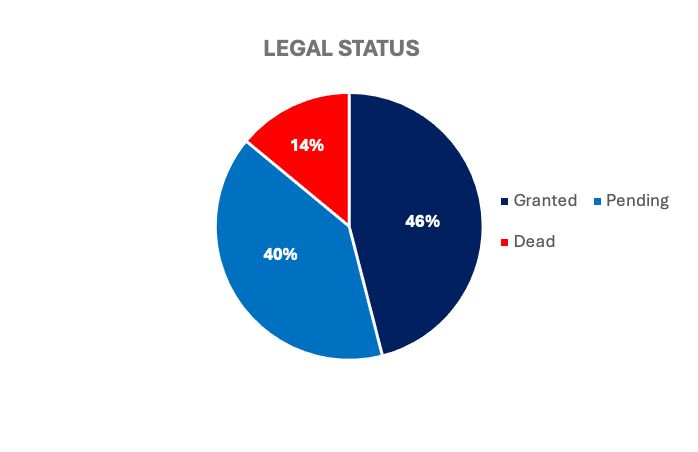
Figure 5: Legal Status
The dataset includes 1,108 patent families filed in the past 20 years. A large majority remain active (86%), highlighting a relatively steady and ongoing innovation trend, which is expected for a field characterized by long development cycles. A smaller portion are dead (14%), suggesting natural lifecycle attrition.
The landscape contains a diverse mix of industrial and academic contributors. Industrial applicants (68%) represent a slightly larger share of the portfolio, indicating strong commercial interest in translating quantum sensing advances into practical applications for autonomous navigation.
Academic and research institutions (32%) also play a substantial and influential role, underscoring the scientific depth and foundational research supporting this technology. Their contribution is essential for advancing core principles and enabling long-term innovation.
This balanced distribution between industrial and academic actors reflects a maturing technological domain in which both applied innovation and fundamental research progress in parallel, reinforcing each other and driving sustained development.
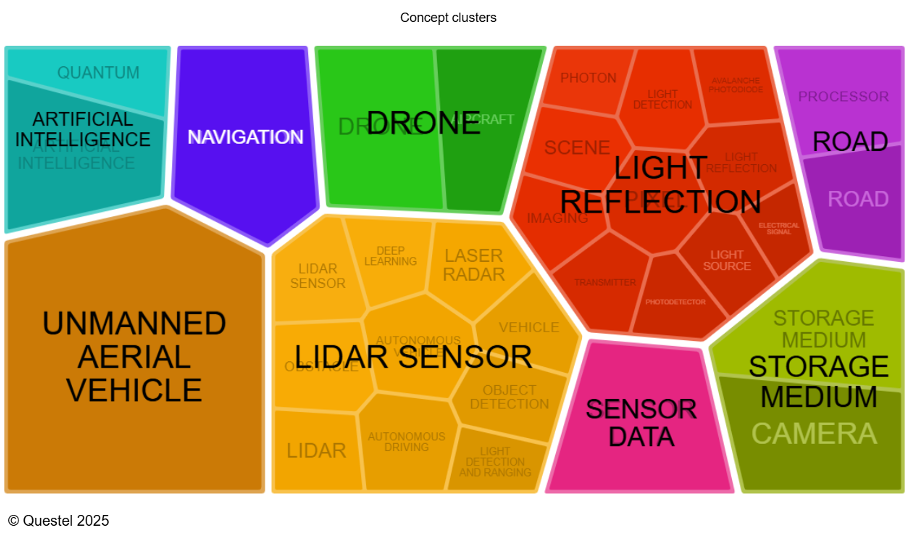
Figure 6: Core Concept Clusters in Quantum Sensing for AVs
The concept-cluster map shows that quantum sensing patents for autonomous systems cluster strongly around LiDAR, optical detection, and sensor data processing. Additional clusters reveal significant activity in drone and UAV platforms, along with enabling technologies such as navigation algorithms, artificial intelligence, and on-board data storage. Overall, the map highlights a landscape dominated by optical quantum sensing but deeply interconnected with autonomous navigation and AI-driven perception.
—Key Trends: Filing periods
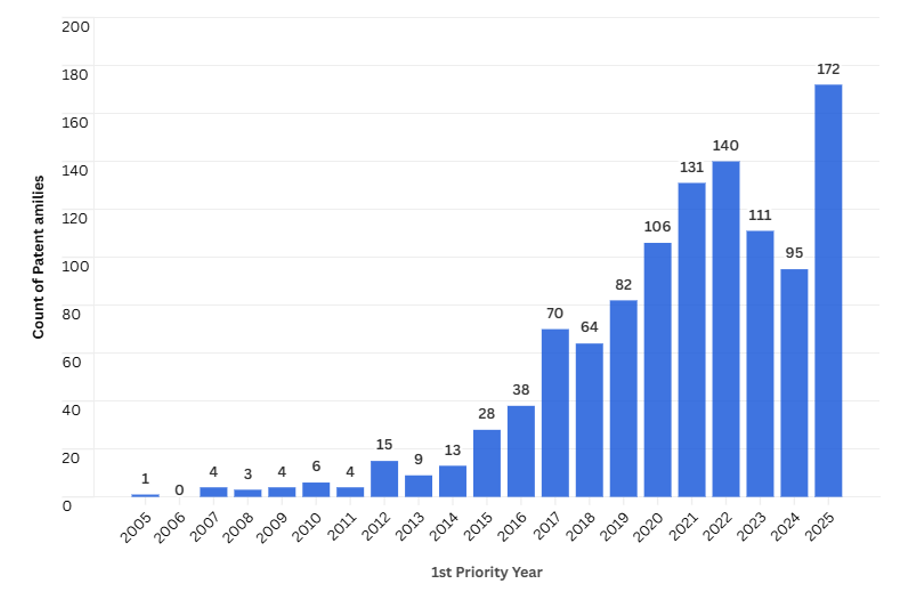
Figure 7: Patent Filing Trends ©Questel
In the period from 2005 to 2014, patent filings grew steadily from 1 to 13 families, resulting in a CAGR of approximately 33%. This period reflects the early formation of the field, where foundational research and preliminary technological developments were gradually taking shape.
From 2015 to 2025, the overall long-term trend shows a strong expansion of innovation, rising from 1 to more than 170 patent families. This corresponds to a CAGR of around 20%, confirming the sustained interest and maturing technological landscape surrounding quantum sensing for autonomous systems. A clear peak is observed in 2022, marking the highest annual filing activity to date and reflecting an exceptional concentration of R&D efforts during that year.
A visible dip in 2023 stands out in an otherwise regular upward trajectory. Similar patterns have been observed in several technological sectors and are commonly associated with post-COVID publication delays, which affected the standard release timelines in multiple patent offices worldwide.
The 2024–2025 counts remain high but incomplete due to the standard 18-month publication delay. This suggests that the momentum in quantum sensing for AVs is likely to persist, with new developments on the horizon, and indicates that key players in the autonomous vehicle sector are still heavily investing in cutting-edge technologies that will push the boundaries of vehicle autonomy.
—Top Applicants
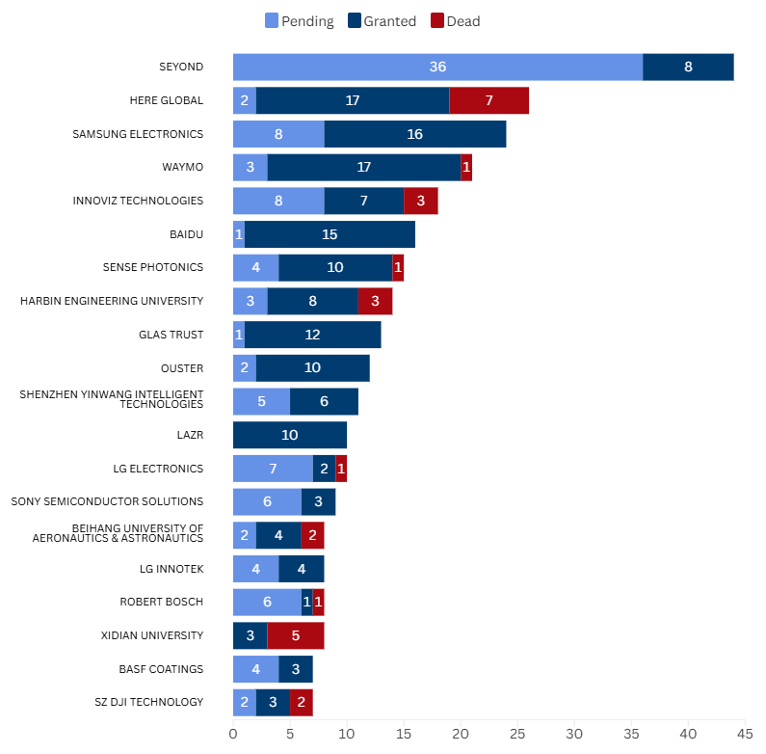
Figure 8: Top 20 Applicants by Legal Status ©Questel
The chart above highlights the top 20 patent assignees in quantum sensing technologies for autonomous vehicles (AVs), offering a clear view of the organizations shaping this emerging field.
- Seyond stands out as the leading player, with an impressive portfolio of 44 families (36 pending and 8 granted). The high share of pending patents indicates very recent and aggressive innovation, likely in areas such as quantum LiDAR and quantum-enhanced ranging, showing Seyond’s intention to secure early leadership in a fast-evolving domain. This pattern typically reflects a fast-growing R&D pipeline and a desire to secure early leadership in a nascent but disruptive domain.
- HERE Global follows with 26 families (17 granted), reflecting mature, validated technologies that may enhance positioning, mapping, and localization, key pillars of autonomous navigation.
- Major electronics companies, including Samsung Electronics, LG Electronics, Sony Semiconductor Solutions, and LG Innotek, also rank highly, supported by portfolios largely composed of granted patents. Their activity points to advancements in quantum photonics, quantum dot sensors, and chip-level integration, aimed at improving sensitivity and signal quality in AV sensing modules.
- Automotive and mobility leaders, including Waymo, Baidu, and Robert Bosch, show meaningful activity as well. Their focus is probably directed toward integrating quantum sensors into LiDAR, inertial measurement units (IMUs), and GNSS enhancement systems, in order to overcome limitations of classical sensing, like performance in adverse weather, drift, and signal interference.
- Several academic institutions, such as Harbin Engineering University, Beihang University, and Xidian University, play a strong role, reflecting intense research efforts in Asia. Their work often targets foundational technologies like quantum magnetometers and cold-atom interferometers.
- Meanwhile, companies known for classical LiDAR, such as Innoviz Technologies, Ouster, and Sense Photonics, are increasingly exploring quantum-enhanced approaches to push the boundaries of long-range detection and resolution.
Overall, the mix of industrial leaders, sensor manufacturers, AV pioneers, and research institutions reveals a dynamic and competitive innovation landscape, with quantum sensing rapidly emerging as a key enabler of higher-accuracy and more robust autonomous perception.
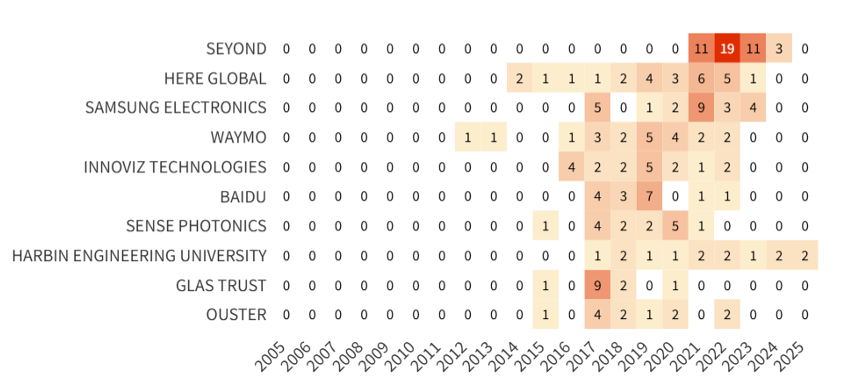
Figure 9: Top 10 Applicants Filing Trends ©Questel
The heatmap shows that patenting activity in quantum sensing for autonomous vehicles (AVs) is highly recent, with activity accelerating from 2016 and peaking between 2020 and 2023. Seyond stands out with a sharp surge from 2020 and a peak in 2022, confirming its role as a fast-growing innovator. HERE Global, Samsung Electronics, and Waymo display more gradual or intermittent activity, reflecting steady but targeted investment in quantum-enhanced mapping, photonics, and sensing integration. Chinese players such as Baidu and Harbin Engineering University show consistent filings since 2017, indicating strong academic and industrial engagement. Companies traditionally focused on classical LiDAR, Innoviz Technologies, Sense Photonics, and Ouster appear with sporadic entries, suggesting exploratory steps toward quantum-enhanced architectures. Overall, the heatmap reveals a young and rapidly accelerating innovative landscape, driven by recent entrants racing to secure early leadership in quantum sensing for AVs.
However, when focusing specifically on 2025, the landscape becomes much more fragmented. Although 172 patent families were filed that year, none of the main applicants contributed more than two filings (Harbin Engineering University). The majority of the activity instead comes from academic institutions such as Chandigarh University, Harbin Engineering University, Jiangsu University, NRI Institute of Technology, the State Grid Hubei Electric Power Research Institute, and the Inner Mongolia University of Technology. These actors typically file single, highly specialized patents and therefore do not appear among the Top 10 applicants, which explains why the year shows strong overall volume but very little concentration among leading players.
—Priority Areas and Extension Strategies
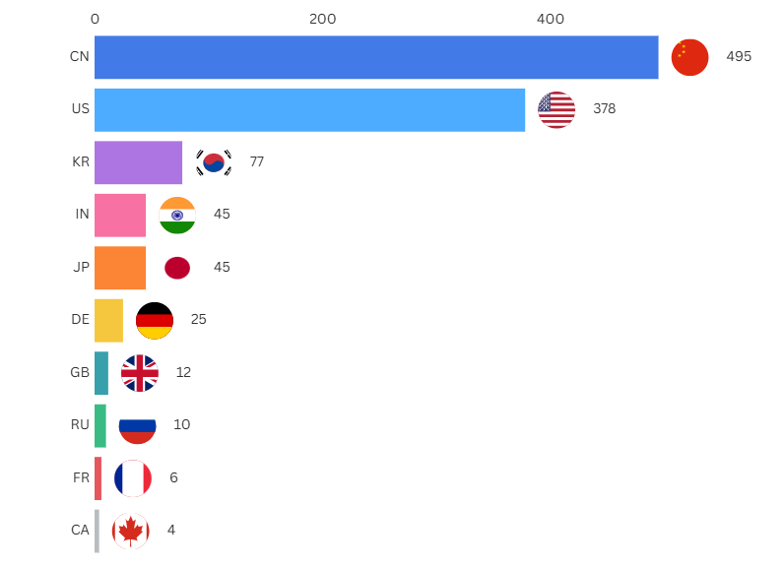
Figure 10: Patent Families by Priority Countries ©Questel
The country distribution reveals a strong geographic concentration of patent activity in quantum sensing for autonomous vehicles. China leads decisively with 495 patent families, reflecting large-scale national investment in quantum technologies, advanced sensing, and intelligent mobility. The United States follows with 378 families, underscoring its significant role in quantum research and autonomous vehicle innovation.
A second tier of contributors includes South Korea (77), India (45), and Japan (45), showing growing interest across Asia in quantum-enhanced perception systems. European participation remains more modest, with Germany (25), the United Kingdom (12), and France (6), suggesting early but developing engagement in this emerging field. Russia (10) and Canada (4) also appear with limited yet notable involvement.
Overall, the landscape is dominated by China and the U.S., indicating a global race led by major technological powers, with Asian countries emerging as active followers and Europe still in the early stages of adoption and exploration.
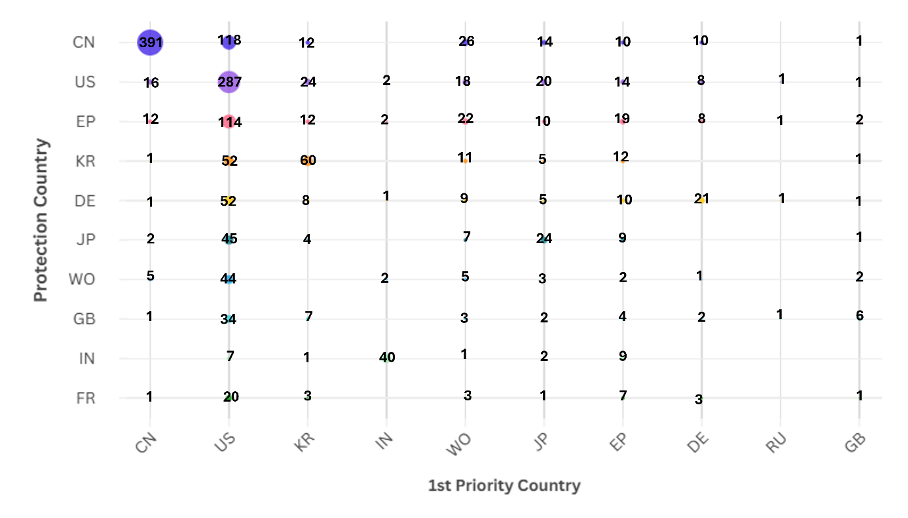
Figure 11: Extension Strategy ©Questel
The filing patterns reveal distinct extension strategies across regions. China stands out with a strong national extension approach, reflected by the high volume of protection filings within its domestic system for inventions that originate locally. Similar patterns appear across other Asian jurisdictions, such as South Korea and Japan, where applicants often prioritize consolidating protection in their home markets before seeking broader international coverage.
In contrast, the United States adopts a more outward-looking strategy. A significant share of US priority filings is extended to major global jurisdictions, including EP, CN, JP, KR, and via the PCT procedure, indicating an early ambition for worldwide protection. This approach suggests a strategy geared toward global market reach and cross-border commercialization.
Even with fewer priority filings, Europe, South Korea, and Japan remain key destinations for protection. Their importance stems from the industrial and technological significance of these markets, particularly in automotive engineering and advanced electronics, making them strategic targets for safeguarding valuable innovations.
—Leading Industrial Players
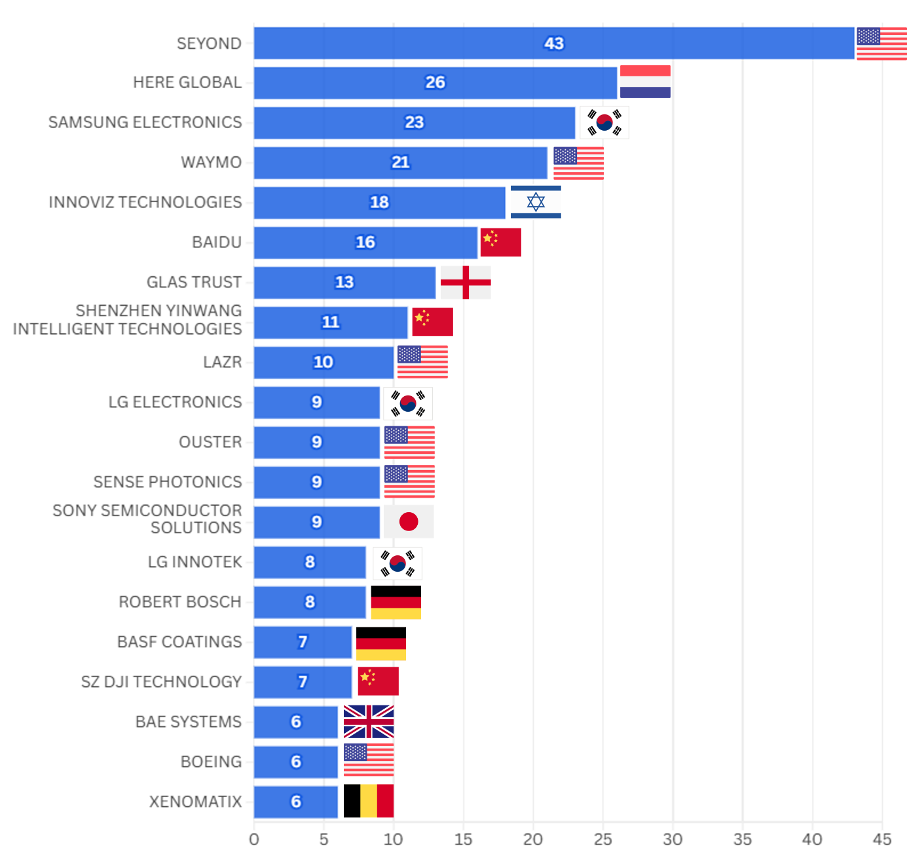
Figure 12: Leading Industrial Applicants and their Geographic Origins in Quantum-Sensing Patent Filing ©Questel
The data shows that the United States is the dominant origin of industrial patent activity, with multiple top-ranking companies such as SEYOND, Waymo, Ouster, Sense Photonics, Boeing, and LAZR, appearing prominently. South Korea, China, and Europe (notably Germany, the Netherlands, the UK, and Belgium) also contribute significantly, though with fewer high-volume applicants.
Overall, the distribution indicates that U.S. industrial players lead the global landscape, followed by strong contributions from East Asian companies (South Korea, China, Japan) and select European innovators. This geographic concentration suggests that quantum sensing for autonomous vehicles is primarily driven by industrial ecosystems with advanced automotive, semiconductor, and sensing-technology sectors.
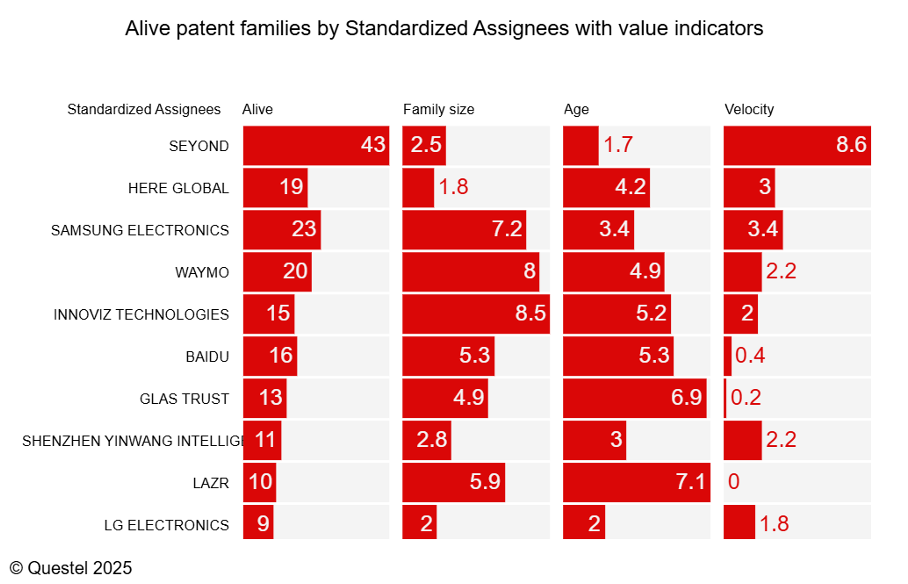
Figure 13: Patent Portfolio Dynamics and Value Indicators of Leading Industrial Assignees
SEYOND stands out with a remarkably high velocity value (8.6), far surpassing all other players, indicating an exceptionally active and fast-moving patenting strategy. This suggests SEYOND is aggressively expanding its portfolio and pushing innovation at a pace unmatched in the dataset.
By contrast, most other companies show moderate to low velocity levels. HERE Global, Samsung Electronics, and Waymo maintain steady activity, while others, such as BAIDU, GLAS TRUST, and LAZR, show minimal recent expansion.
The velocity indicators suggest that some players, particularly SEYOND, are accelerating their patenting activity, while others maintain more stable or slower filing rates. Such differences may illustrate how innovation strategies are shifting across the LiDAR and autonomous-vehicle sector.
—Segmentation by AV Types
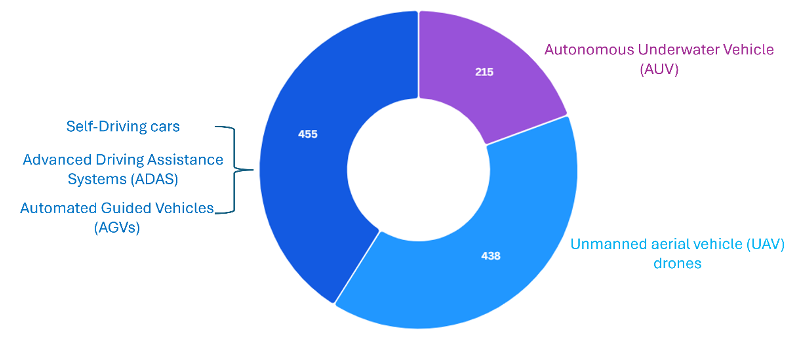
Figure 14: Analysis of Autonomous Vehicle Patent Distribution ©Questel
This donut chart reveals the patent landscape distribution across different autonomous vehicle technology sectors, illustrating where innovation efforts are concentrated:
- Terrestrial Dominance: The largest segment comprises Self-Driving cars, Advanced Driving Assistance Systems (ADAS), and Automated Guided Vehicles (AGVs) with 455 patents, representing approximately 42% of the total portfolio. This substantial concentration reflects the massive commercial potential and competitive intensity in ground-based autonomous transportation, where companies are racing to achieve full autonomy across consumer vehicles, semi-autonomous safety systems, and industrial logistics solutions.
- Aerial Applications: Unmanned Aerial Vehicles (UAV) drones account for 438 patents (roughly 40% of the portfolio), nearly matching terrestrial vehicles. This near-parity demonstrates the explosive growth in drone technology spanning commercial delivery, agricultural monitoring, infrastructure inspection, defense applications, and recreational uses, indicating that autonomous flight represents an equally critical innovation frontier.
- Marine Exploration: Autonomous Underwater Vehicles (AUV) comprise the smallest segment with 215 patents (approximately 20%). While representing a smaller market, this still-substantial patent activity reflects specialized applications in oceanographic research, underwater infrastructure inspection, defense operations, and resource exploration, where autonomy solves unique challenges of remote underwater environments.
This multi-domain approach indicates that companies recognize that autonomous technology's transformative potential extends far beyond traditional automotive applications.
UAVs Vs. Self-Driving Cars: Where Innovation Is Really Accelerating
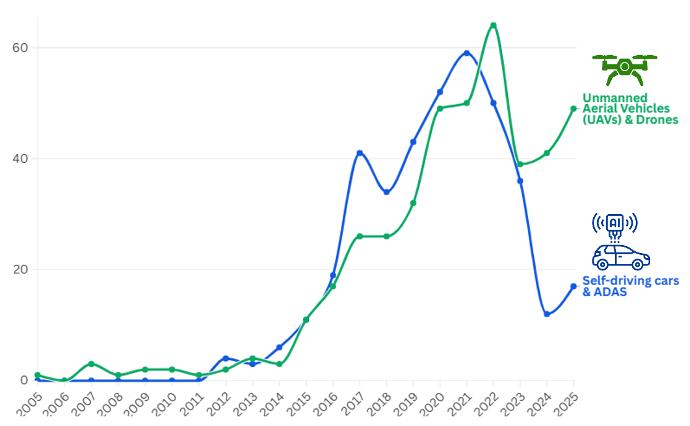
Figure 15: Temporal Patent Trends: UAVs vs. Self-Driving Cars & ADAS ©Questel
The temporal evolution of patent filings reveals a decisive divergence between UAV innovation and the self-driving car and the ADAS segment. Until 2015, both domains advanced at a comparable pace. But from 2016 onward, we can see a turning point in commercial drone adoption with the curves separating sharply. UAV-related patents accelerate faster, peaking around 2022 and maintaining strong momentum through 2025. In contrast, self-driving and ADAS technologies experience sharper volatility and a pronounced decline after 2022.
This widening gap is not accidental; it reflects structural differences in market readiness. UAVs benefited from early regulatory frameworks, clearer deployment pathways, and rapid commercialization across high-impact sectors such as agriculture, energy inspection, delivery logistics, and emergency response. These industries enabled iterative testing in controlled or semi-controlled airspaces, allowing autonomous capabilities to mature quickly.
Self-driving cars, by comparison, remain tightly constrained. The graph’s post-2022 drop illustrates stalled progress caused by complex safety validation, fragmented road regulations, and the persistent challenge of mass deployment in unpredictable urban environments. Even with ADAS bundled in, terrestrial autonomy fails to match UAV momentum.
Ultimately, as the graph visualizes, UAVs dominate because the sky offers fewer regulatory, infrastructural, and operational obstacles than the road. This divergence doesn’t just reflect the present state of innovation; it signals the trajectory of future autonomous markets, where aerial systems are positioned to lead the next wave of commercial adoption.

Innovation In Quantum Sensing Technologies: Conclusion
As autonomous systems continue to evolve, one pattern becomes unmistakably clear: the future of autonomy will be defined by sensing. Classical perception technologies, despite decades of refinement, are reaching fundamental physical limits that constrain the safety, robustness, and scalability of autonomous vehicles. Quantum sensing emerges not merely as an upgrade, but as a transformational leap, enabling machines to perceive with unprecedented precision even in environments where today’s systems fail.
Patent dynamics confirm this shift. Across industrial leaders, mapping giants, LiDAR manufacturers, and automotive innovators, the race is accelerating toward quantum-enhanced navigation, measurement, and perception.
The divergence between UAVs and self-driving cars further underscores this transition. Aerial autonomy is scaling faster because it operates in a more permissive regulatory, infrastructural, and operational space, allowing quantum sensing to be commercialized sooner and more effectively. Meanwhile, terrestrial autonomy faces a slower, more complex path, making quantum sensing not just useful but essential to overcoming its most persistent barriers.
Ultimately, the integration of quantum sensors into autonomous vehicles is not a distant vision. It is already reshaping R&D priorities, competitive dynamics, and deployment strategies across industries. The organizations that invest early in quantum-enhanced perception will define the next decade of autonomous mobility on the ground, underwater, and increasingly, in the skies.
Patent landscape analysis can provide valuable insights into research and innovation trends and markets, as we hope this analysis of Quantum sensing integration in autonomous vehicles. For further details on patent activity in this sector or for specific advice or support on any other topic, contact the Questel IP Consulting team.