
- Patent
- Our Patent solutions
- IP Intelligence SoftwareStreamline the journey from innovation to IP with our IP intelligence software, patent search, data analytics, and related services and tools.→ Read more
Our solutionsPowerful patent searching and analysisArtificial intelligence for patent classificationGrant statistics and detailed legal status analysisSmall molecules searching and analysisDNA and amino acid searching and analysisExplore new markets and opportunitiesEasy patent searching and collaborationAnalysis from any scientific sourcesUnlock AI-powered use cases across a range of Questel software.SEP DatabaseNEWStandard Essential Patent Data & AnalyticsLatest resources- → AVERA-IP Selects Questel’s Qthena to Enhance AI-Driven Patent Drafting and Prosecution WorkflowsAVERA-IP Selects Questel’s Qthena to Enhance AI-Driven Patent Drafting and Prosecuti...
- → Types of Intellectual Property: Definitions, Examples, and Strategic Value Understand the key types of intellectual property—patents, trademarks, copyrights, a...
- → The World’s Leading Wi-Fi Owners—2026Download the newest report from Patently, assessing ownership of standard essential ...
- → AVERA-IP Selects Questel’s Qthena to Enhance AI-Driven Patent Drafting and Prosecution Workflows
- IP Management SoftwareKeep your assets up to date and aligned with your corporate strategy with our Equinox suite of IP management software.→ Read more
Our solutionsPowerful all-in-one IPMS for corporatesIPMS tailored for large corporates, built on SalesforcePowerful all-in-one IPMS for law firmsIPMS tailored for large Law FirmsCollaborative invention-to-filing workflowLatest resources- → How to Leverage GenAI for Advanced Patent and Trademark WorkflowsFrom invention disclosure and patent drafting to office action response management a...
- → 7 Data Security Features You Need in Your IP Management SoftwareIP management software is evolving rapidly, with vendors and users embracing the pot...
- → Does Your IP Management Technology Connect Your People, Processes, and IP Assets? To drive real efficiency across their IP management practices, portfolio owners must...
- → How to Leverage GenAI for Advanced Patent and Trademark Workflows
- AI Assistants for Patent ProductivityOptimize your entire patent process with our advanced AI assistants for patent productivity, from patent application drafting to prosecution workflow automation, claims mapping, and office action responses.→ Read more
Our solutionsQthenaNEWAll-in-one patent prosecution workflow, data, and collaboration workspace.Patent Mapping and Claim Analysis with AIPatent Office Action Response Management with AILeverage the power of data to guide your patent prosecution with Prosecution PackIndustry-leading patent drafting software powered by generative AI.Latest resources- → How Can AI Help IP Practitioners Manage Responses to Office Actions? The latest AI tools for IP law firms and corporations are helping IP practitioners s...
- → Generative AI and IP Practice: The New StandardPatent and trademark attorneys once viewed generative AI with skepticism. Confidenti...
- → Murgitroyd Case Study: Significant Time Saved with Qthena and Reinvested into IP StrategiesA leading IP law firm, Murgitroyd set out to remove workflow bottlenecks, strengthen...
- → How Can AI Help IP Practitioners Manage Responses to Office Actions?
- Patent ServicesBenefit from end-to-end support for vital but time-consuming administrative tasks with our complete range of patent support services, including searches, translations, international filings, validations, unitary patent management, recordals, renewals, and more→ Read more
Our solutionsPatentability, Freedom-To-Operate, InvalidityPCT & national phase, Paris Convention, Unitary PatentUnitary Patent and Unified Patent Court servicesSimplified European validation servicesCentralized patent translation servicesFee and renewals managementAssignment and recordal of all IP RightsLatest resources- → MicroPort NeuroScientific Selects Questel for Patent Filing, Translation, Unitary Patent, and EP Validation Services By partnering with Questel, MicroPort NeuroScientific gains access to integrated IP ...
- → AI, Efficiency, and Trust: What’s Really Changing in Patent Translation? AI is reshaping patent translation, but not by replacing human expertise. It is chan...
- → PCT FILING GUIDENational phase filing requirements across 50 of the most frequently selected PCT jur...
- → MicroPort NeuroScientific Selects Questel for Patent Filing, Translation, Unitary Patent, and EP Validation Services
- Patent Strategy & Administration→ Read more
Control costs, streamline invoices, and safeguard your patent rights efficiently with our patent strategy & administration services and tools
Our solutionsEnd-to-end IP admin, data verification and docketingInvoice review, bundling and paymentFee audits, negotiation, compliance, benchmarks and forecastingLandscaping, benchmarking, valuation and licensingDefensive PublicationBUY ONLINEPublish an invention into the public domainLatest resources- → Cut Intellectual Project Cost and Reduce Inefficiency: What Can In-House Legal Teams Do? There is always pressure on intellectual property costs. Indeed, an in-house legal t...
- → Centralized Patent Management Services Deliver 20% Cost Savings for Autoliv Henning Koch, IP & Patent Director at Autoliv, shares his insights and positive expe...
- → The 4 Elements of a Cost-Effective Legal DepartmentHow can a legal department reduce operational costs without sacrificing quality? Wha...
- → Cut Intellectual Project Cost and Reduce Inefficiency: What Can In-House Legal Teams Do?
- Trademark
- Our Trademark solutions
- Clearance & Watch PlatformScreen and monitor your brand and trademark rights effectively with our trademark clearance search and trademark monitoring platform→ Read more
Our solutionsScreen trademarks with AI-driven search technologyMarkify Comprehensive SearchBUY ONLINEAI-driven trademark availability softwareBest-in-class trademark results paired with key pharmaceutical sourcesWatch for new, identical and confusingly similar trademarksMonitor marketplaces, social media, and web contentLatest resources- → TALKUAL Selects Markify Watch to Strengthen Its Brand Protection Strategy As TALKUAL continues its international growth journey, protecting and strengthening ...
- → Pointon Partners Selects Questel’s Markify platform to Screen and Monitor his Brand and Trademark Rights EffectivelyWe are excited to announce that Pointon Partners has selected Markify, our trademark...
- → How ZEISS Strengthens its Online Brand Protection and Trademark Searches with QuestelHolger Gensmantel, Head of Trademarks, shares how Questel supports the brand defense...
- → TALKUAL Selects Markify Watch to Strengthen Its Brand Protection Strategy
- IP Management SoftwareManage and maintain your trademark, design and domain name rights effectively with our state-of-the-art trademark management software→ Read more
Our solutionsPowerful all-in-one IPMS for corporatesIPMS tailored for large corporates, built on SalesforcePowerful all-in-one IPMS for law firmsIPMS tailored for large law firmsCollaborative workflow for trademark and design proposalsLatest resources- → How to Leverage GenAI for Advanced Patent and Trademark WorkflowsFrom invention disclosure and patent drafting to office action response management a...
- → 7 Data Security Features You Need in Your IP Management SoftwareIP management software is evolving rapidly, with vendors and users embracing the pot...
- → Proof of Use in Practice: Managing PoU with AI in UZ.IPProof of use often creates friction in trademark workflows. Time pressure, difficult...
- → How to Leverage GenAI for Advanced Patent and Trademark Workflows
- AI Assistants for Trademark ProductivityReview trademark search and watch results, create first drafts of goods and services descriptions, classify evidence of use, and manage office action responses effectively with Qthena, our AI assistant for trademark productivity.→ Read more
Our solutionsQthenaNewAll-in-one digital trademark workflow automationChat with trademark search or watch results to review findings and assess riskSave time and build consistency and compliance with our AI solutionAnalyze content and draft answers with AIManage trademark evidence of use with AILatest resources- → How Can AI Help IP Practitioners Manage Responses to Office Actions? The latest AI tools for IP law firms and corporations are helping IP practitioners s...
- → Murgitroyd Case Study: Significant Time Saved with Qthena and Reinvested into IP StrategiesA leading IP law firm, Murgitroyd set out to remove workflow bottlenecks, strengthen...
- → How to Leverage GenAI for Advanced Patent and Trademark WorkflowsFrom invention disclosure and patent drafting to office action response management a...
- → How Can AI Help IP Practitioners Manage Responses to Office Actions?
- Trademark, Design & Domain Services→ Read more
Access expert support throughout the complete brand lifecycle with our integrated domain name, design, and trademark solutions
Our solutionsAnalyst-driven searches with on-demand and customizable reportingIP asset monitoring with intelligent pre-selectionCase management and take-down servicesInternational registration process supportTrademark and design renewal servicesEffective management of corporate domain namesAssignment and recordal of all IP rightsEnd-to-end IP admin, data verification, docketingLatest resources- → Stop Searching for Registered Trademarks Online: You’re Wasting Time and Money If you only search for registered trademark rights online, you will miss many import...
- → No IP Docketing System? Keep a Clean and Efficient Legal Docket with Questel Making sure your IP legal docket is an effective resource can be a challenge, but th...
- → Managing Renewals with a Dedicated Intellectual Property Platform: How Does It Work? Traditional methods of managing IP renewals are labor-intensive and relatively high-...
- → Stop Searching for Registered Trademarks Online: You’re Wasting Time and Money
- Innovation
- Our Innovation solutions
- Innovation Management SoftwareMake your innovation management processes faster, efficient and scalable with our end-to-end innovation management platform.→ Read more
Our solutionsBusiness-oriented dashboards for innovatorsStartup deal flow and program managementInnovation Project ManagementUnlock AI-powered use cases across a range of Questel software.Your central cockpit for your strategic AI projectsLatest resources- → The Critical Role of Human Input in AI-Powered DecisionsWhy AI needs human input to deliver business value, and how innovation leaders are i...
- → How to Choose the Best Open Innovation Platform for Your Business NeedsYour innovation platform should provide a dynamic space where you can share ideas, t...
- → Why You Should Focus on Innovation Even at Times of Crisis Investing in innovation and innovation management is essential not only during stron...
- → The Critical Role of Human Input in AI-Powered Decisions
- Innovation ServicesSuccessful innovation processes and culture are about more than the right software tools. Our innovation services leverage proven methods and approaches to generate insights, ideas, and solutions.→ Read more
Our solutionsMarket screening, Competitive intelligence and Technology scoutingConnect with partners, improve or localize your innovation processProducts and services namingSeamless user experience to a global audienceEngage with new audience globallyLatest resources- → 7 Key Questions to Measure Innovation Management Success Innovation is the key to staying competitive in today’s fast-paced business world. H...
- → Software Patent: How Can It Be Done?Even though life without computers is today nearly impossible to imagine, patent-bas...
- → What is Innovation Scouting?Change is a constant. New technologies emerge regularly, reshaping product landscape...
- → 7 Key Questions to Measure Innovation Management Success
- Solutions
- Solutions
- Artificial Intelligence in IP→ Read more
Discover Questel’s holistic and responsible approach to artificial intelligence
and intellectual property and our vision to inspire the future of IP with AI
Our solutionsDiscover how AI is transforming IPIndustry-leading patent drafting software powered by generative AIAI copilots for optimized patent preparation and prosecution workflowsAI copilot for automated patent classificationAI copilot for elevated trademark clearance searchUnlock AI-powered use cases across a range of Questel software.Proof of UseNewCapture Trademark Evidence of Use with AILatest resources- → From Risk to Reward: What Our 2026 Industry Outlook Research Reveals About AI in IPThe latest edition of our IP Industry Outlook Research shows that AI is providing a ...
- → Generative AI and IP Practice: The New StandardPatent and trademark attorneys once viewed generative AI with skepticism. Confidenti...
- → Murgitroyd Case Study: Significant Time Saved with Qthena and Reinvested into IP StrategiesA leading IP law firm, Murgitroyd set out to remove workflow bottlenecks, strengthen...
- → From Risk to Reward: What Our 2026 Industry Outlook Research Reveals About AI in IP
- Integrated IP Ecosystem→ Read more
Optimize your intellectual property assets with our comprehensive IP portfolio management solutions,
ensuring maximum protection and strategic advantage for your business.
Our solutionsIP management systems, docketing, forecasting, data analytics, blockchain, and eBilling toolsOur web-based platform for IP services managementPAVIS Connect, our solution for companies and laws firms that already have an IP management systemAccess trademark watches directly from Equinox with Markify Watch integrationLatest resources- → Types of Intellectual Property: Definitions, Examples, and Strategic Value Understand the key types of intellectual property—patents, trademarks, copyrights, a...
- → IP Valuation Services for Smarter Business DecisionsIn today’s knowledge-driven economy, intellectual property (IP) assets often hold mo...
- → Switching to a New IPMS: What Does the Data Migration Process Involve?When you’re considering switching to a new IP management system (IPMS), you’ll likel...
- → Types of Intellectual Property: Definitions, Examples, and Strategic Value
- Solutions for Law FirmsStreamline internal processes, satisfy client demand, and remain competitive with our specialist solutions for law firms→ Read moreOur solutionsAll-in-one patent prosecution workflow, data, and collaboration workspace.Patent Office Action Response Management with AIIndustry-leading patent drafting software powered by generative AIPowerful all-in-one IPMS for law firmsPowerful patent searching and analysisScreen and monitor your trademark rights effectively with our Markify platformStreamline multilingual matters with fast and reliable legal translation servicesCentralized patent translation servicesFee and renewals managementTrademark and design renewal servicesLatest resources
- → How Equinox Law Firm Supports Redchip Lawyers to Save Time and Build RelationshipsFor law firms with large, multi-disciplinary practices, an IP management system (IPM...
- → Can Your IPMS Help Build Strong Client Relationships?Cultivating strong client relationships is incredibly important for IP law firms. Yo...
- → Leverage Artificial Intelligence to Simplify Your Prosecution WorkUnlock exclusive insights and discover how Qthena, the AI-powered prosecution assist...
- → How Equinox Law Firm Supports Redchip Lawyers to Save Time and Build Relationships
- Solutions for Life Sciences→ Read more
Intellectual property management tools, services, and insights to support life sciences innovation strategies
Our solutionsDNA and amino acid searching and analysisSmall molecules searching and analysisExplore new markets and opportunitiesBest-in-class trademark results paired with key pharmaceutical sourcesPowerful all-in-one IPMS for corporatesTranslation solutions across the product lifecycle—from patent to post-marketCentralized patent translation servicesFee and renewals managementTrademark and design renewal servicesLSPN North America Awards recognize QuestelLatest resources- → Patent Data Analytics, It’s Not Just for Patent SearchingThere are many reasons why organizations may conduct patent searching exercises and—...
- → Harnessing the Power of Patent AnalyticsPatent analytics can reveal new application areas, diversification opportunities, an...
- → The Technology Landscape of Precision Medicine: An IP AnalysisTechnological developments in gene sequencing, imagery, and data analysis are enabli...
- → Patent Data Analytics, It’s Not Just for Patent Searching
- Solutions for R&D and Innovation→ Read more
Strengthen, structure, and maximize your R&D and innovation strategy, workflows, and internal processes by harnessing the latest tools and technologies, including through smart application of generative AI.
Our solutionsCreate more efficient and scalable innovation management processesCollaborative invention-to-filing workflowCollaborative worklfow for trademark and design proposalsMarket screening, competitive intelligence, and technology scoutingStreamline your research and development workflows with AILatest resources- → 3 Cutting-Edge Solutions to Support Your R&D and Innovation Strategies Discover how the latest cutting-edge software and AI-elevated processes for research...
- → 7 Key Questions to Measure Innovation Management Success Innovation is the key to staying competitive in today’s fast-paced business world. H...
- → AI Patents: What Patent Mapping Can Tell Us About Future AI Technologies Artificial intelligence (AI) is evolving all the time thanks to the growing quantiti...
- → 3 Cutting-Edge Solutions to Support Your R&D and Innovation Strategies
- Language Solutions→ Read more
Translation, interpretation and tech-enabled localization services and language solutions that help global organizations open up new markets, overcome regulatory hurdles and connect with audiences worldwide.
Our solutionsStreamline multilingual matters with fast and reliable legal translation servicesTranslation solutions across the product lifecycle—from patent to post-marketManage operations, ensure compliance, and maintain consistent messaging worldwideLatest resources- → Creating Organization-Wide IP Awareness: How Leading Companies Strengthen Innovation and Reduce RiskHaving an organization wide IP Awareness is essential! But how companies can build a...
- → Employing A "Winning Strategy" For Your International MattersYear after year, in-house legal teams and outside counsel handling international and...
- → The Role Clinical Trial Translation Plays in Patient Recruitment and RetentionHealth equity is an essential goal in modern healthcare, and one pivotal aspect of a...
- → Creating Organization-Wide IP Awareness: How Leading Companies Strengthen Innovation and Reduce Risk
- Contact
- Learn & Support
- Learn and support
- Webinars & EventsAre you interested in attending one of our online or onsite event?
- Product TrainingsCustomer success is our priority. Increase your skills in the use of Questel’s software
- Product NewsA platform dedicated to software and platforms news and evolutions
- Best-in-class Customer ExperienceOur goal is to exceed our clients' expectations and share best practices
- IP TrainingIncrease the IP-IQ of your entire organization with engaging IP training programs
- Newsletter subscriptionSign up for our quarterly patent and trademark newsletters and set your email preferences below.
- Webinars & Events
- Resource HubStay up-to-date with industry best practices with our latest blogs
- Resource Hub
- About Questel
- Learn & Support
- Learn and support
- Webinars & EventsAre you interested in attending one of our online or onsite event?
- Product TrainingsCustomer success is our priority. Increase your skills in the use of Questel’s software
- Product NewsA platform dedicated to software and platforms news and evolutions
- Best-in-class Customer ExperienceOur goal is to exceed our clients' expectations and share best practices
- IP TrainingIncrease the IP-IQ of your entire organization with engaging IP training programs
- Newsletter subscriptionSign up for our quarterly patent and trademark newsletters and set your email preferences below.
- Webinars & Events
- Resource HubStay up-to-date with industry best practices with our latest blogs
- Resource Hub
- About Questel

A Guide to Federal Rule of Evidence 902: How to Avoid Litigation Collection Minefields
Original doeLEGAL Source - 2020, By Adam Bowers, JD.
Revised April 25, 2023
Pronounced changes to the Federal Rules of Evidence (FRE) have occurred over the past years. Some are broader in scope, while others create more dramatic effects on the eDiscovery process. The amendment to Federal Rule of Evidence 902 has caused many corporate entities to question whether they should continue to allow self-collections of their own litigation data or if they will avoid risks and exposure by hiring a 3rd-party professional service provider to oversee the collection tasks.
The favorable news for US-based corporations is that the amended Federal Rule of Evidence 902 does not require forensic collection experts. Still, there remain some critical reasons to consider seeking the expertise of an outside legal collections expert to ensure proper procedures are in place and followed.
Introduction to the Amended Federal Rule of Evidence 902
Attorneys must understand and optimally participate in identifying, preserving, and collecting their clients' ESI (Electronically Stored Information). Today, courts are more tech-savvy and less forgiving of any ignorance regarding eDiscovery collection practices. This paper provides an overview of self-collection and a cost-benefit analysis of the DIY (do it yourself) model from a lawyer's perspective, not a marketing perspective. An important distinction is drawn here because doeLEGAL and Questel are not forensic collection companies; we offer best-of-breed data collection techniques and practices, using advanced technologies and partners to ensure clients can make effective decisions. The intent is to take an honest look at the issues surrounding how corporate clients gather and identify ESI data to present strong evidence during litigation.
NOTE: This blog is not to be considered legal advice. If you need legal advice, consult with a state-licensed attorney. With that said, let's look at the changes Federal Rule of Evidence 902 brought to life and its impact on eDiscovery collections.
Dangers of allowing employees to conduct legal holds, manage their own data, and administer a self-collection
With eDiscovery technology evolving rapidly, companies often get mired in the weeds, forgetting that humans remain a considerable part of the litigation equation. One past case exemplified the significant expense of allowing employees to preserve their own litigation data: GN Netcom, Inc. v. Plantronics, Inc. The case has become so recognizable in eDiscovery circles, much like Zubulake, that it joins the infamous "single name club" – it's now known as "Plantronics." In this case, a senior member of management instructed his sales team to delete certain emails and other data in direct contradiction to a company-instituted legal hold on those email accounts. The intent of the sales manager was seen as malicious, and the Delaware Federal Judge was not amused. The court sanctioned Plantronics in the amount of three million USD, plus associated fees and costs. While Plantronics proved to be victorious on the merits of the case, it was still liable for the millions in spoliation-associated costs: "They lost the battle but won the war." While the Plantronics case serves as an example of intentional destruction of litigation data, there are also less nefarious reasons that employees should not be left to manage their own data preservations or collections.
Another notable case demonstrated why the process of a client collecting their own documents for litigation, commonly known as "self-collection," is risky and generally frowned upon by courts unless specific circumstances warrant it. Self-collection can potentially jeopardize the client's best interests and the integrity of the case. In fact, one judge expressed deep concerns regarding this practice, as evidenced in EEOC v. M1 5100 Corp., d/b/a Jumbo Supermarket, Inc., Civil No. 19-cv-81320 (S.D. Fla. July 2, 2020).
When clients collect their own ESI for litigation, they may not completely understand the legal and ethical responsibilities involved. This can lead to issues such as over-collection or under-collection due to concerns about self-incrimination or conflicts of interest. Attorneys should instruct their clients to avoid self-collection practices since they must certify a client's self-collection and production efforts (as required by FRCP 26(g)). While self-collection is not inherently flawed, self-selection often poses significant risks in the legal process.
What is self-collection?
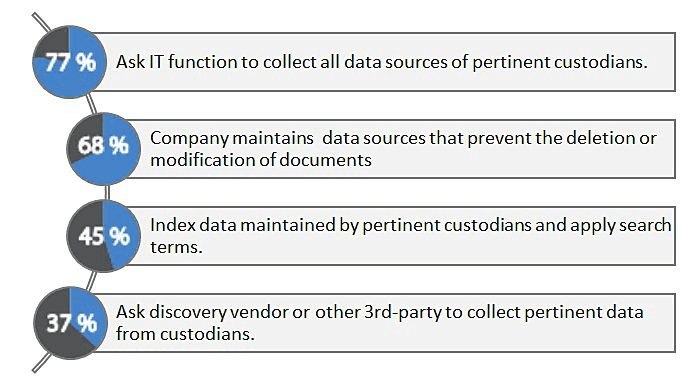
Before we get too far into the concepts of preservation and collection, let's define "custodian self-collection" using the two methods used most often. One is where the custodians are responsible for preserving, searching, and identifying their data while IT would do the actual collection (gathering of ESI). The second is where the custodians are responsible for preserving, searching, identifying, and collecting their own data. Each method has many of the same challenges and risks, but the first method is more common in business, so we will use that as our reference.
In a past webcast, 62% of the attendees were concerned with spoliation risks associated with custodian self-preservation. However, in a survey of corporate counsel, 47% of organizations relied on custodian self-preservation more than 75% of the time. A clear split exists between what they know is right and doing what's right. Another thing to keep in mind when exploring how not to over-collect comes from employing a "collect everything" approach to preservation, a practice that creates its own apparent issues, such as increased costs, larger volumes of data to review, and potential risk in other legal matters.
An additional example of the dangers of custodian self-collection comes from Nat’l Day Laborer Org. v. US Immigration and Customs Enforcement Agency, government employees from several different agencies attempted to compile data in connection with a FOIA (Federal Rules of Evidence Freedom of Information Act) request. There was a general lack of supervision, and the employees were Federal Rules of Evidence to search their own email accounts. But several ex-employees never had their emails searched at all, which prompted Judge Scheindlin to order the parties to meet again and confer to formulate search criteria and procedures. Scheindlin pointed out that there was no clear identification process in place, and the employees were directed to identify personally created data, which was not a normal work duty. One of the major issues was that those government employees were not even aware of where their custodial data was stored, so when they merely searched their shared drives, many records were entirely overlooked.
Despite spending thousands of hours and hundreds of thousands of dollars on the exercise, the court opined that "Transparency is indeed expensive, but it pales in comparison to the costs to a democracy of operating behind a veil of secrecy". The courts have long disfavored custodian self-collection because it is not systematic, repeatable, and defensible. Judge Scheindlin went so far as to say, "Most custodians cannot be 'trusted' to run effective searches[…]" This may explain why Federal Rule of Evidence 902 was amended to require the certification of a collection by a "qualified person." Attorneys should be involved in all aspects of the preservation and collection of their clients' litigation-data, no matter who performs the physical collection. But the new Federal Rule of Evidence 902 does not directly speak to attorney involvement.
It is notable that the Chancery Court of Delaware had all but placed an outright ban on unsupervised self-collection of employee data. In Roffe v. Eagle Rock Energy GP, LP, et al, CA No. 5258-VCL (Del. Ch. April 8, 2010), the Court of Chancery addressed party self-selection of the documents to be produced in litigation. “This is not satisfactory. Attorneys should not rely on their clients to search their own email systems. There needs to be a lawyer who makes sure the collection is done properly.”
Where, oh where, has my data gone?
The over-collection of litigation data is often the norm, and we explored some of the dangers you face in doing so already. Collecting enough is not the same as over-collecting. Steve Bunting, CEO of Bunting Digital Forensics, said, “You never know when a spoliation claim will come up, and getting everything up front puts you in a far better position down the road.” By creating a forensic image of a device or server, you may just be capturing data that you did not know you would need later. For instance, imaging a laptop will save the entire hard drive, including something called "Federal Rules of Evidence space". Without getting too technical, Federal Rules of Evidence space is the part of a drive that contains deleted items or file fragments. When someone deletes a file, devices will break it into several pieces and send it to the hard drive's Federal Rules of Evidence space. A skilled forensic expert may be able to retrieve and reconstruct ESI from this Federal Rules of Evidence space, which could be important if opposing counsel is accusing your client of intentional or negligent spoliation.
So what's the bottom line here when it comes to self-collection problems? It's really quite simple: most employees don't understand what to collect or from where to collect it. This is where a forensic collections expert can help unravel this problem by creating a "data map" that shows all custodial devices (office, mobile, and personal), any instance of third-party data hosting (emails, social media, sales platforms, etc.), and internal and external storage locations. This visual depiction can be beneficial during a self-collection because it provides a "treasure map" to the data that can be easily understood and actioned.
Any reasonable attorney must take into account the human factor and safeguard against risks, including the intentional deletion of data and the sluggishness of their client's employees.

Federal Rule of Evidence 902: What's the attorney's role in the process?
While we won't cover the legal hold process in this whitepaper, it involves many of the same issues as a collection, including the identification and supervision that the collection process presents. In short, it is impossible to collect what has not been preserved, and it is equally impossible to preserve what has not been identified. With so much at stake, responsibility for preservation and adequate collection practices falls on the attorney. Because of this added responsibility, involvement in the process throughout the life cycle of litigation is crucial to protecting the client's best interests.
Early in the identification process, a litigation attorney must be vigilant about what custodial data is involved and where that data is stored. First, the scope of the litigation determines the breadth and depth of the attorney's responsibility to safeguard any data that may fall within that scope. This practice is not limited to data they know to be part of a current litigation, but extends to data that may be part of future litigations. In effect, the FRCP and the Federal Rules of Evidence make an attorney the fiduciary of litigation data for current or potential future litigations.
How does this relate to self-collections? Even attorneys involved in the litigation do not always know what data or evidence may be relevant, so it is reckless to believe that employees possessing ESI will be able to make this judgment. The best course of action is to meet with opposing counsel and design a legal hold that will reasonably capture as much relevant ESI as possible. This may include scheduled meetings with identified or potential custodians to ensure compliance with legal holds.
It is important to point out that the ABA has expressly recommended that attorneys understand their client's use of technology (Rule 1.1 comment 8). Additionally, most US states have made technology competency a part of their Model Rules of Professional Conduct. However, some of the language used by the states is quite vague and speaks to a standard of care akin to avoiding negligence.
One final area that should be addressed is the "chain of custody." An attorney should maintain a proper, well-documented ESI chain of custody, which starts with the identification and collection of the litigation data and continues throughout the litigation's life. Any alteration to collected data is traced back to the party in control of it at the time of the alteration. Comparing the hash values is a quick and easy way to identify if a document was altered, but this also presumes that metadata has been preserved and collected. Treat ESI like you would any other piece of trial evidence. It is essential to know and understand the life cycle of the trial evidence to maintain accurate records of your efforts.
Conclusion to the Attorney's Guide to Federal Rule of Evidence 902 – Avoiding Self-Collection Minefields
Investing money upfront to hire a professional or train internal employees to perform forensically sound collections can stave off future pitfalls associated with using and reviewing litigation data. Keeping in mind that the most expensive aspect of an eDiscovery project is the time that attorneys or paralegals spend reviewing the ESI that was collected, it becomes even more apparent that investing in proper collection practices is cost-justified. Familiarize your team with Federal Rule of Evidence 902 to ensure you follow the amended rule and provide the best advice to your client to protect everyone's best interests! In the digital data era, the Federal Rules of Evidence Rules will continue to evolve to match the current needs.
There are many moving parts to eDiscovery: Human, technical, legal, and ethical. By ensuring that companies follow the proper legal holds and collection practices, an attorney may perfectly position themselves to safeguard their client from possible sanctions for spoliation and reduce the resources spent by litigation support and review professionals. Whatever the amount of money that might be saved by following a DIY model of self-collection, this will certainly be outweighed by extra resources spent by litigation support professionals, reviewing attorneys, and the need to hire trial experts to authenticate the data collected.
The best defense is staying up-to-date on trends and requirements for ESI in litigation. This whitepaper covering Federal Rule of Evidence 902 is one part of that information-sharing initiative Questel is driving for the Legal market. When exploring if you should engage in ESI self-collection, consider the old English sailing proverb, "A stitch in time saves nine," which loosely means that a timely effort today can prevent more work later, is still applicable to modern-day litigation practices.
For specific advice or more insight on the information shared in this blog, get in touch with our experts.
Adam Bowers is a former employee of doeLEGAL, A Questel Company. Adam is an eDiscovery expert, LLM candidate, a former business owner, and legal technology practitioner who helps law firms and attorneys navigate the complex world of eDiscovery.